
ภาษาไทย | English

Metallurgical Engineering
DTA Thailand Company: Casting Simulation and CFD Application Engineer, Product Manager
Jewelry Casting Simulation Expert
Phatthana Namracha
phatthana@dtathai.com
A gold ring may appear simple and elegant on the outside, but achieving a flawless casting requires careful control of every stage of the process. In 18K gold investment casting, complex geometry, thin sections, rapid heat loss, and the high value of the material leave very little room for trial and error.
This case study demonstrates how FLOW-3D CAST can be used to visualize the complete casting process before production begins. By analyzing molten metal flow, temperature distribution, air entrapment, and solidification behavior, simulation provides deeper insight into what happens inside the mold, helping engineers evaluate casting conditions, improve process design, and reduce costly experimentation with precious 18K gold.
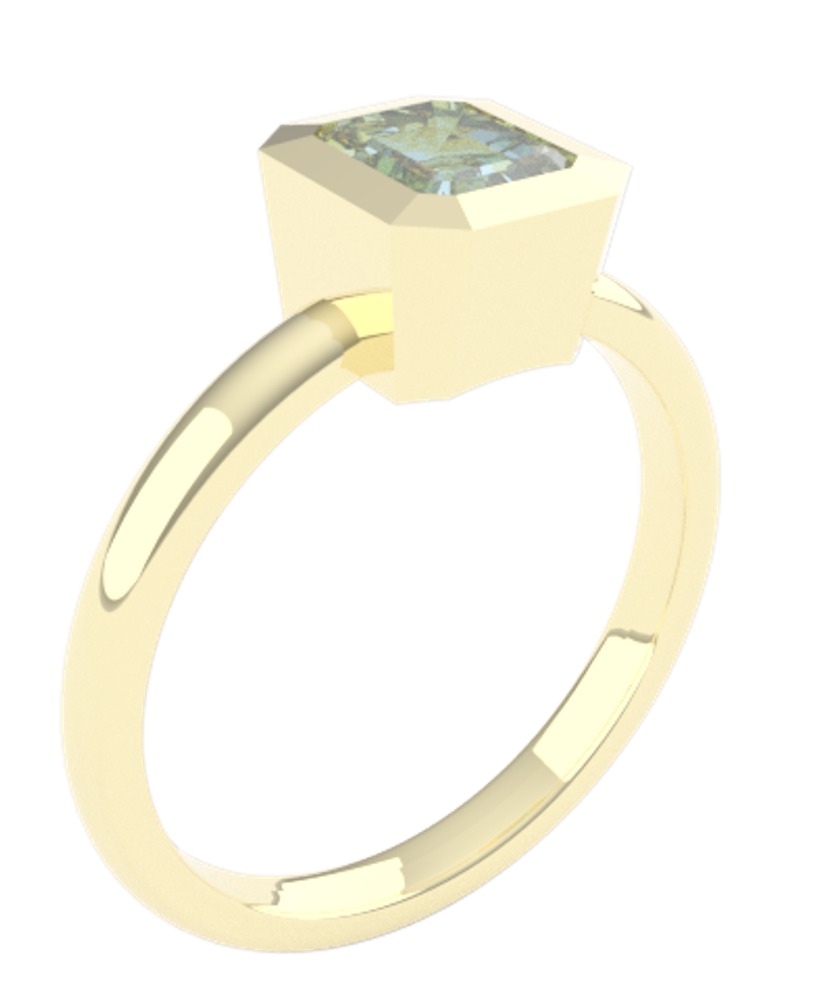
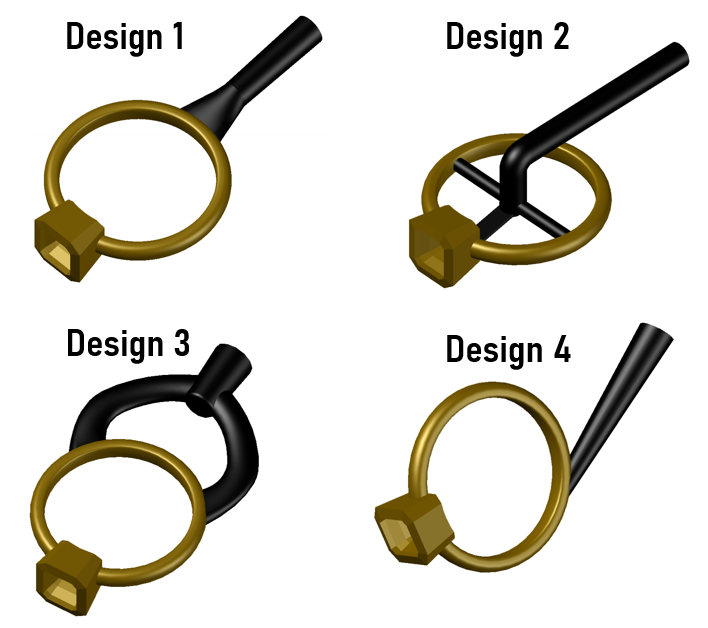
Figure 1. Selection of the Best Design from Different Gating System Configurations
Today, FLOW-3D CAST is the most widely used casting simulation software among our customers in Thailand’s jewelry industry, with growing interest from manufacturers seeking deeper and more accurate engineering insight into their casting processes.
For this case study, an 18K gold ring was selected as the test component for evaluating the investment casting process using FLOW-3D CAST. The simulation was used to investigate the behavior of the molten metal throughout mold filling, temperature evolution, air entrapment, and solidification. This approach provides detailed insight into what occurs inside the mold – information that is difficult to observe directly during an actual casting process – and allows potential defect risks and casting conditions to be evaluated before production.
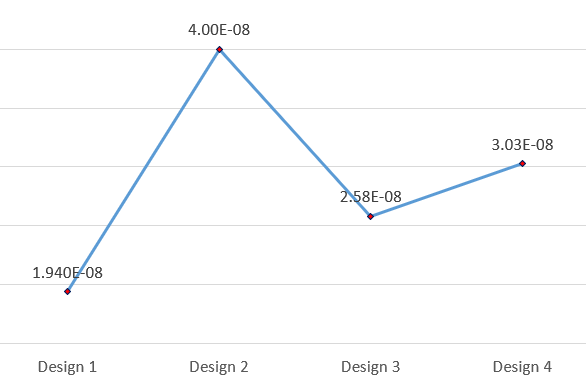
Figure 2. Entrained Air Mass Concentration for 4 different gating designs (kg)
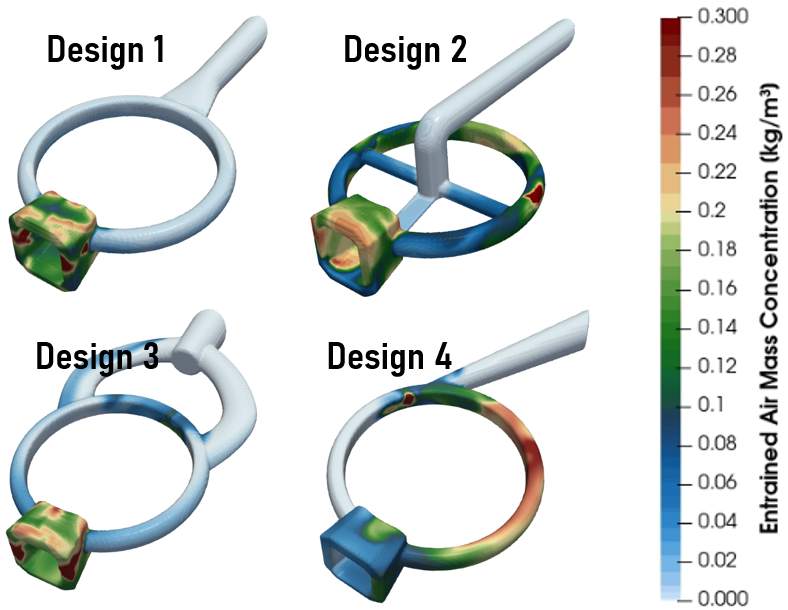
Figure 3. Simulation results showing the locations of entrained air mass after complete filling
The results show that Design 1 has the lowest entrained air value (1.94 × 10⁻⁸ kg), with air mainly concentrated around the ring head and only limited distribution along the band. Design 2 shows the highest value (4.00 × 10⁻⁸ kg), with a broader air distribution along the ring band and internal flow paths. Designs 3 and 4 show moderate levels, with Design 4 exhibiting more noticeable air entrapment along one side of the ring band.
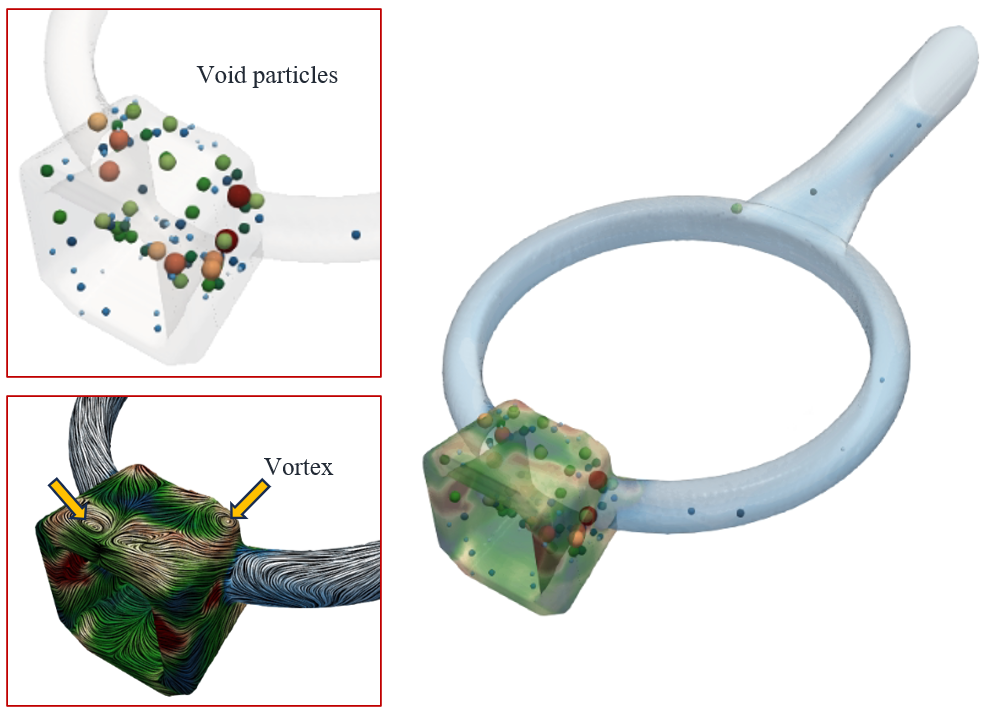
Figure 4. Void particles and flow pattern reveal a vortex on Design 1
FLOW-3D CAST can provide deeper insight into the origin of air entrapment. In this case, void particles are concentrated around the ring head, while the flow pattern reveals vortex formation in the same region, indicating that recirculating flow can trap air within the molten metal during filling.
Note: Void Particles indicate locations where gas or voids become trapped within the molten metal, highlighting areas with potential risk of porosity or internal void defects in the casting.
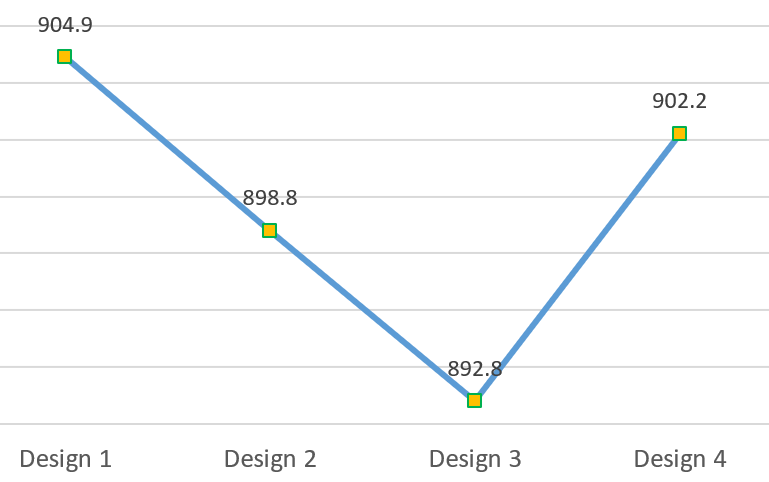
Figure 5. Temperature for 4 different gating designs (°C)
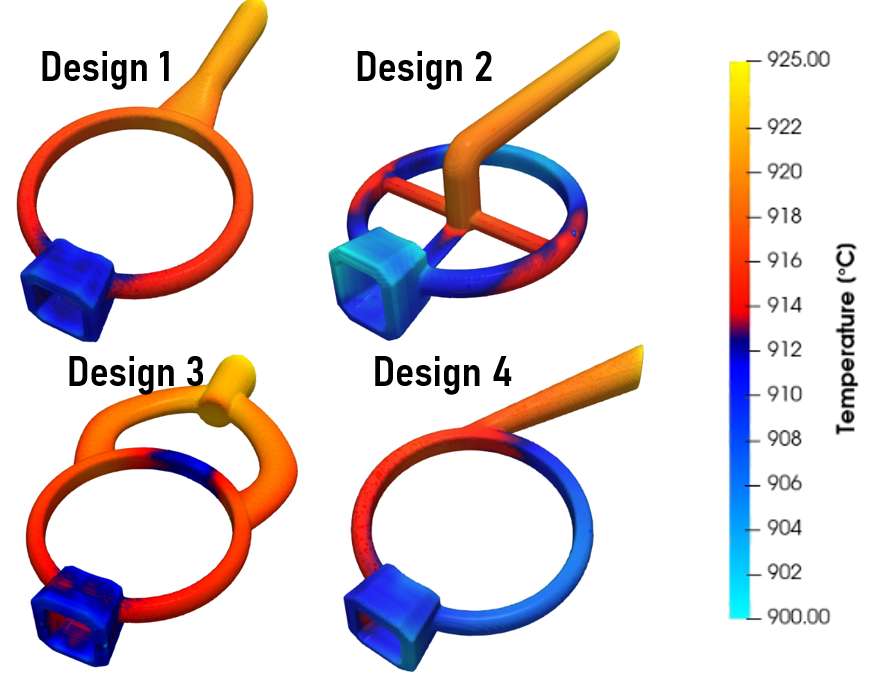
Figure 6. The locations of temperature after complete filling
The simulation results show that Design 1 has the highest temperature after complete filling at approximately 904.9°C, while Design 3 has the lowest at about 892.8°C. This indicates that the gating configuration directly influences heat loss and temperature distribution during mold filling.
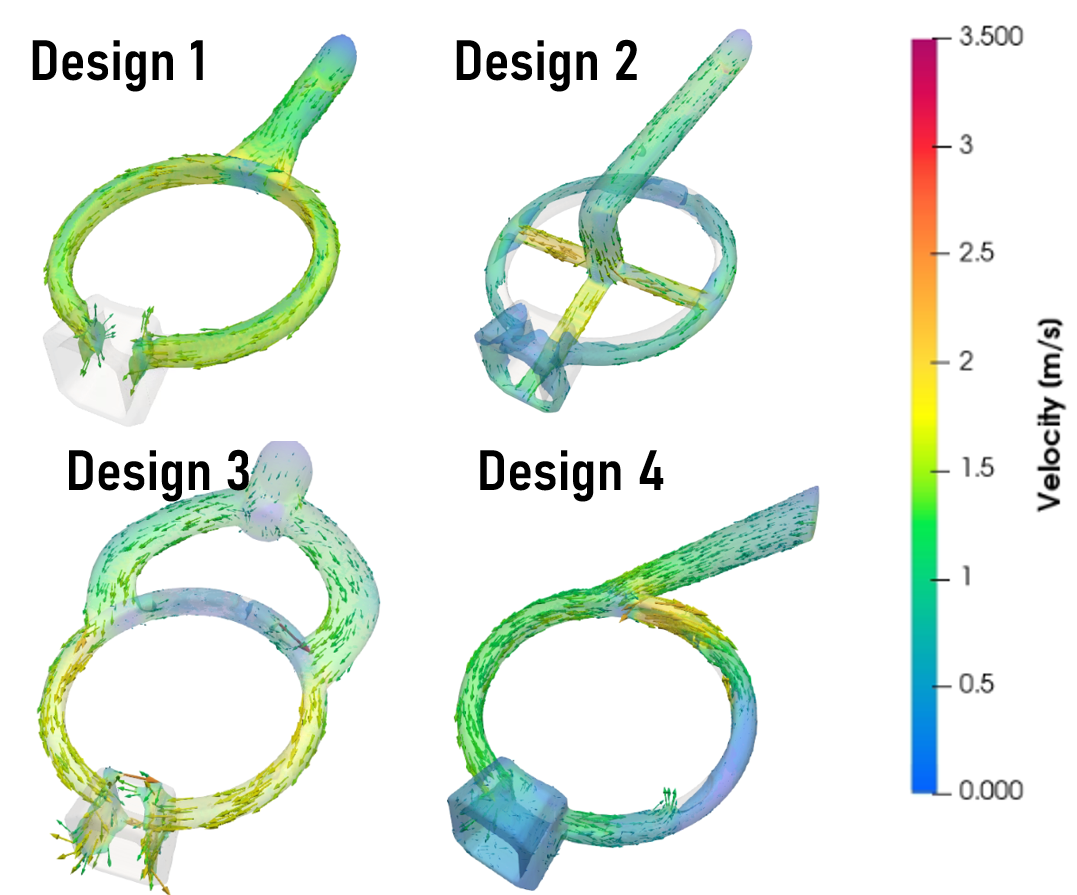
Figure 7. Comparison of molten metal flow behavior for different gating designs
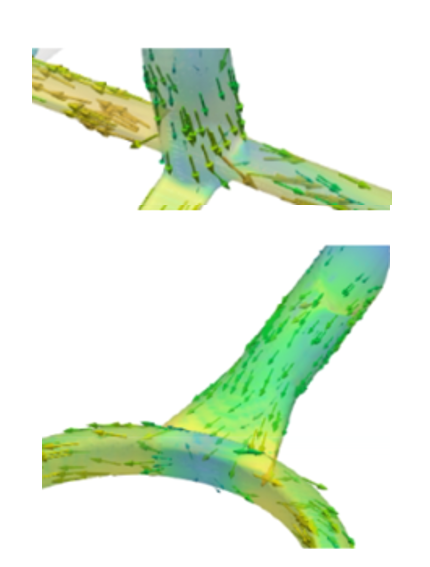
Among the four designs, Design 1 shows the smoothest and most continuous flow pattern, with the molten metal traveling mainly in one direction around the ring and with fewer flow collisions. In contrast, Design 2 exhibits multiple flow splits and merging regions, creating a more complex flow pattern and a higher potential for recirculation and air entrapment.
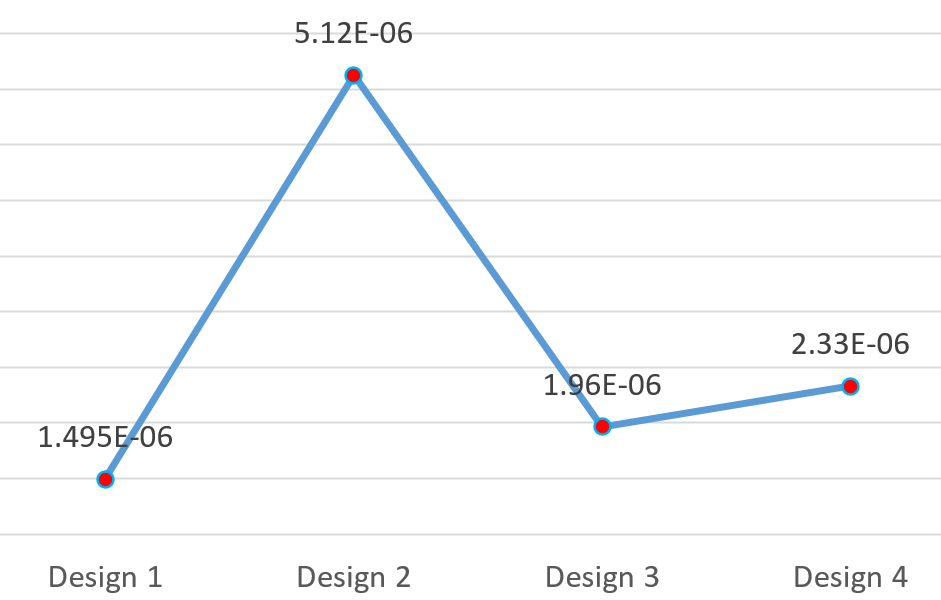
Figure 8. Comparison of Free Surface Defect for Four Gating Designs
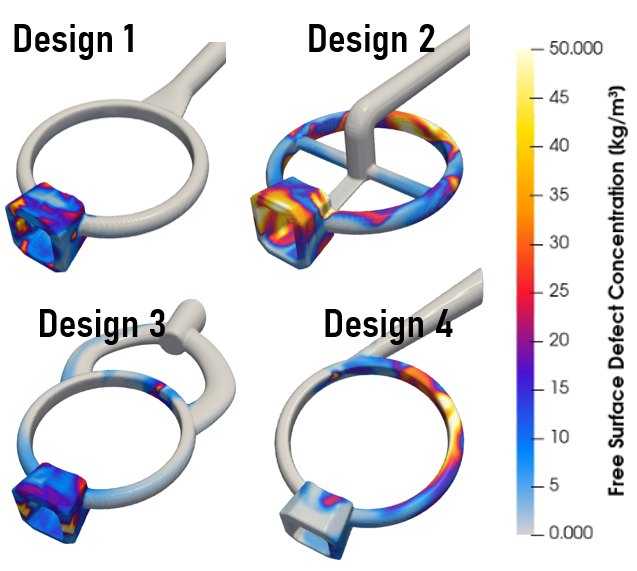
Figure 9. Distribution and Locations of Free Surface Defect for Four Gating Designs
The simulation in Figures 8 and 9 indicates that Design 1 has the lowest tendency for oxide-related defects, with the risk mainly concentrated around the ring head. Design 2 shows a broader and more continuous distribution along the ring band, which may increase the likelihood of surface imperfections or internal defects. Designs 3 and 4 exhibit intermediate behavior, with Design 3 showing a more localized distribution, while Design 4 presents more noticeable accumulation along one side of the ring band.
At this stage, based on the evaluation of the filling behavior – including flow pattern, temperature distribution, air entrapment, and free-surface-related defects – Design 1 demonstrates the most favorable overall behavior. Its smoother and more continuous flow reduces metal-stream collisions and potential defect formation, making it the selected design for further analysis in the next stage.
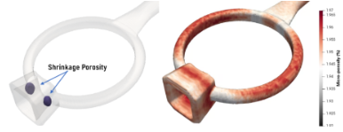
Shrinkage porosity typically forms in slowly solidifying regions where liquid metal feeding is insufficient, while micro-porosity consists of small, distributed voids caused by microscopic shrinkage during solidification.
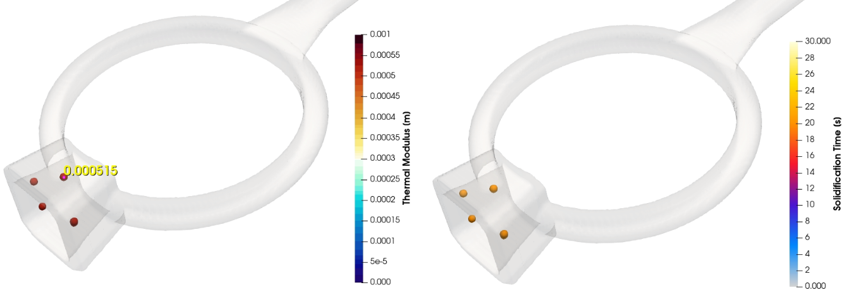
Figure 10. Solidification Analysis of Design 1: Hot Spot, Thermal Modulus, Shrinkage Porosity, and Micro-Porosity
Hot spots and regions with high thermal modulus indicate areas that retain heat and solidify more slowly, making them critical zones during the final stage of solidification.
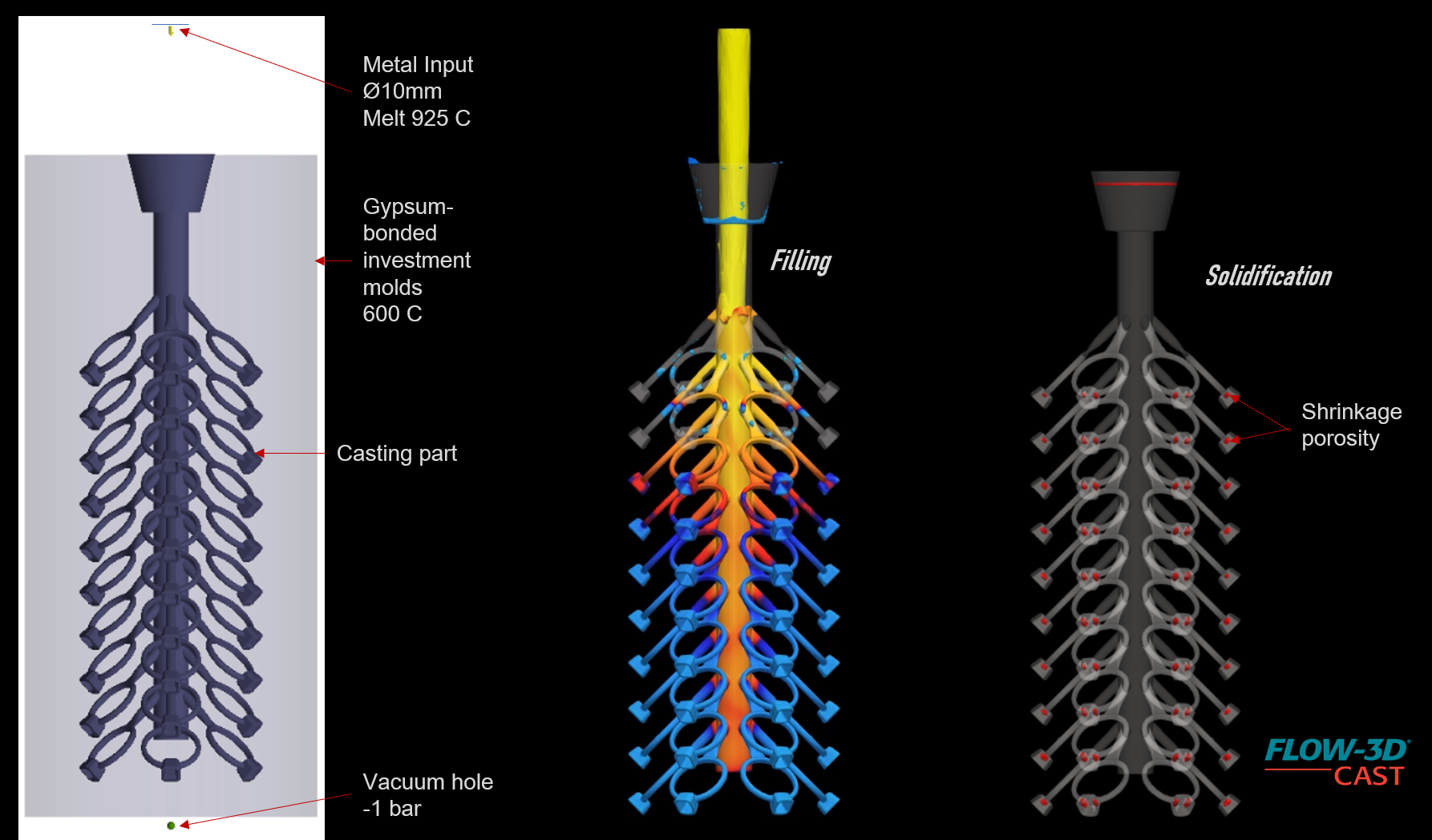
This simulation represents an 18K gold ring casting tree inside a gypsum-bonded investment mold at 600°C, with molten metal introduced at 925°C and vacuum applied at the bottom of the mold. The model is used to evaluate filling behavior, temperature distribution, air entrapment, and solidification throughout the casting tree.
For jewelry casting, FLOW-3D CAST provides clear insight into what happens inside the mold and helps optimize gating, temperature, and casting conditions before actual production.
Authors: Phatthana Namracha
FLOW-3D CAST CASE STUDIES
by
Design Through Acceleration Co.,Ltd
ภาษาไทย | English